Tuesday, June 22, 2021

11 Golf Cart Safety Tips


Whether you're using a golf cart out on the links or for driving up and down the streets of your community, there are some tips we'd like to share to help you travel safely as you go.  For many, nothing beats the relaxation provided by a nice, sunny day out on the golf course, but nothing can ruin that good time quite as much as a golf cart accident.

Golf cart accidents can cause anything from minor injuries and/or damage to catastrophic injuries and even death.  According to the Consumer Products Safety Commission (CPSC), there are approximately 15,000 golf cart related injuries annually that are serious enough to warrant a visit to the emergency room.  While some of these accidents are a result of poor manufacturing design, most can be attributed to negligence on the part of those involved.  These are preventable accidents that may have been avoided by knowing and following these tips.

Golf Cart Safety Tips

  1. Learn how to safely operate your golf cart by reading the owner's manual, if available, and follow all safety guidelines.
  2. Make sure the tires on the cart are inflated to the recommended tire pressure.
  3. Golf carts are lightweight and top-heavy, making them fairly easy to flip over if not driven properly.  Avoid sudden or sharp turns and keep your speed within reason.  The number one cause of golf cart injuries is passengers jumping or falling off the cart.
  4. Don't overcrowd your golf cart with passengers.  Everyone riding on your cart should have their own seat.  Don't allow anyone to hang out the side or back of the cart.  Overcrowding makes it easier for passengers to fall off and puts additional strain on the golf cart, making it more difficult to handle safely.  
  5. Just like with a roller-coaster, keep all body parts inside the golf cart.
  6. Just as with any vehicle, don't drink and drive or consume intoxicating substances before or while driving.
  7. Avoid distractions when driving a golf cart (or any vehicle).  This particularly pertains to cell phone use, which the CPSC lists as the number one cause of distracted driving.
  8. Use seatbelts in your golf cart.  While most golf carts don't come equipped with seatbelts, retrofitting them into your cart is fairly easy and well worth the modest cost when considering the added safety you'll enjoy.
  9. Avoid bad weather when possible.
  10. Perform regular maintenance.
  11. Have fun but stay safe!

Wednesday, May 19, 2021

Is Motorcycle Insurance Required?


North Carolina state law requires that all motor vehicles operated on public roads within the state be covered by at least a minimum amount of liability insurance.  This includes motorcycles and motor scooters.  While there are a variety of other insurance coverages available to motorcycle owners, only liability coverage is made mandatory by state law. 

Liability insurance is what helps protect you from financial losses if you are found legally responsible for causing losses to others while operating your motorcycle.  These losses can be in the form of physical injuries, death or property damage/destruction.  The state has set minimum requirements for the amount of mandatory liability coverage which are as follows:

  1. Bodily injury coverage - $30K per person per accident and $60K for all persons per accident
  2. Property damage coverage - $25K per accident
How Much Do You Need?

While these above outlined dollar figures are the minimum amounts of coverage required, you may elect to have higher limits on your policy.  This makes sense, since an accident for which you are held liable can amount to many times these minimums.

Motorcycle liability insurance helps pay for third-party injury expenses including medical costs, lost wages, funeral costs (in the event of a death) and even long-term disability costs.  It also pays for property damage, including damage other vehicles suffer.  It may also pay toward the costs of defending you in court if you're subject to a liability suit.

With liability coverage only paying up to policy limits, it's obvious that any accident you cause could end up costing you many, many times your policy limit if you're only carrying the minimum liability amounts.  Experts recommend you buy five to ten times the required amounts, depending on how much in assets you need to protect.  You might also consider adding an umbrella policy to your coverage.  These policies typically have limits starting at one million dollars.

Additional, Optional Motorcycle Coverage

Although not required by law, there are a number of other types of motorcycle insurance coverage that are highly recommended for anyone riding on two wheels.  Statistics tell us that the majority of motorcycle insurance claims are for single vehicle accidents where liability coverage doesn't come into play.  Cyclists should consider the following:

  • Collision coverage
  • Non-collision (or comprehensive) coverage
  • Uninsured/underinsured motorist coverage
  • Medical payments coverage
Some insurers will offer lower premiums for lay-up insurance when your bike is stored away for the winter.

Friday, May 14, 2021

6 RV Safety Tips


RVing has become an increasingly popular way to travel and vacation, but it also includes a number of potential safety hazards that should be understood before starting out on your RV experience.  Just because you can drive a car doesn't mean you'll be immediately adept at driving a motor coach or towing a trailer.  Let's take a look at some important RV safety tips geared to helping you make the most of your RV travels while remaining both safe and sound.

Six RV Safety Tips

  1. Whether you're renting an RV or already own a rig, the first and most important safety tip is to thoroughly get to know your RV.   You'll need to do some research so that you know the height of your rig, its weight and, especially if it's a trailer, it's weight capacity.   This means how much stuff you can add to your RV and still remain under the manufacturer's weight capacity recommendation.  You'll also need to know how to distribute the weight in your coach or trailer.
  2. Driving an RV is more like driving a big-rig truck than driving a car and the only way to get used to driving something this size is to practice, practice, practice.  Before even purchasing your first RV you should rent a model you like for the day to see how it feels.  You might try this with several different models until you find one you really like.  Lots of maneuvers in an RV are different than you're use to in your car or pickup, including accelerating, braking, passing other vehicles, using only your mirrors to see behind your rig and, most importantly, backing up.
  3. Your RV insurance and emergency roadside assistance should provide you with complete coverage.  If you're pulling a trailer and your pulling vehicle breaks down and needs to be towed, the trailer should also be towed so it's not left unattended on the roadside.
  4. You need to monitor your tire pressure regularly, on your motorhome or on your trailer and pulling vehicle.  Tire blowouts are the reason for many RV accidents.  Under- or over- inflated tires are an accident waiting to happen.  Consider purchasing an automatic tire monitoring system.
  5. Don't speed.  Your RV tires are rated not only for a maximum weight but also for a maximum speed.  Consult your tires' sidewalls.
  6. Get enough rest and don't drive for too many hours on any given day.

Thursday, May 6, 2021

5 Safety Tips for First Time Campers


First-time campers have a great deal to look forward to.  Whether you're venturing out for a solo camping experience, going with your best mate or including the entire family, camping out in nature can be a fun, rewarding adventure that must be experienced to be fully appreciated.

And, while camping can be both fun and entertaining, it also presents a certain degree of danger.  It's important for first-time campers to be aware of these dangers and to take steps to mitigate them wherever possible.

Safety Tips For First-Time Campers

Here are some safety tips to consider for first-time campers.

1. Site Safety

Choosing an appropriate camp site will depend on several factors including age and condition of group members and any physical limitations or medical requirements.  If you're staying at an established campground, you may have access to amenities not available out in the wilds, including restrooms, grocery stores, cell phone service, etc.

2. Fire Safety

Fire danger is ever-present for campers who are cooking and enjoying gatherings around a campfire.  Here are some fire safety tips:

  • Don't build your fire beneath low-hanging trees
  • Keep a water supply and/or fire extinguisher close at hand in case your fire gets out of control
  • Don't leave your fire unattended
  • Put out your fire completely before retiring
  • Utilize available fire pits at campgrounds
3. Insect and Plant Safety

When going for nature hikes, you may sometimes accidentally come in contact with poisonous plants such as poison ivy, poison oak or poison sumac.  Learn what these plants look like, try to avoid them by staying on an established path and have some medications available such as oral antihistamines and topical creams or lotions.  Certain insects such as mosquitos can also be dangerous to your health.  Wear bug spray at all times when camping, even when sleeping, and use mosquito netting.

4. Water Safety

If partaking in water activities know water safety rules.  Know how to swim and, if boating, wear a life jacket.  Read any signs in or around the water and make sure someone in your group knows how to perform CPR.  Don't go into the water in the presence of lightning.

5. Food Safety 

Before your trip you'll need to plan what you'll want to eat and pack it in air/water-tight plastic containers, with perishables stored in an insulated cooler.  Avoid feeding any wild animals and keep food out of their reach!

Tuesday, May 4, 2021

8 of the Worst Camp Safety Mistakes


Venturing out into nature to experience the great variety of available camping activities has long been popular and, with spring here and summer on the way, the time to start making plans is now.  While some folks might be impulsive in deciding to go camping, there's something to be said about being properly prepared.  Like every Boy Scout learns, "Be Prepared" are words to live by to help avoid common camp safety mistakes.

The Worst Camp Safety Mistakes

In no particular order, following are some of the worst camp safety mistakes:
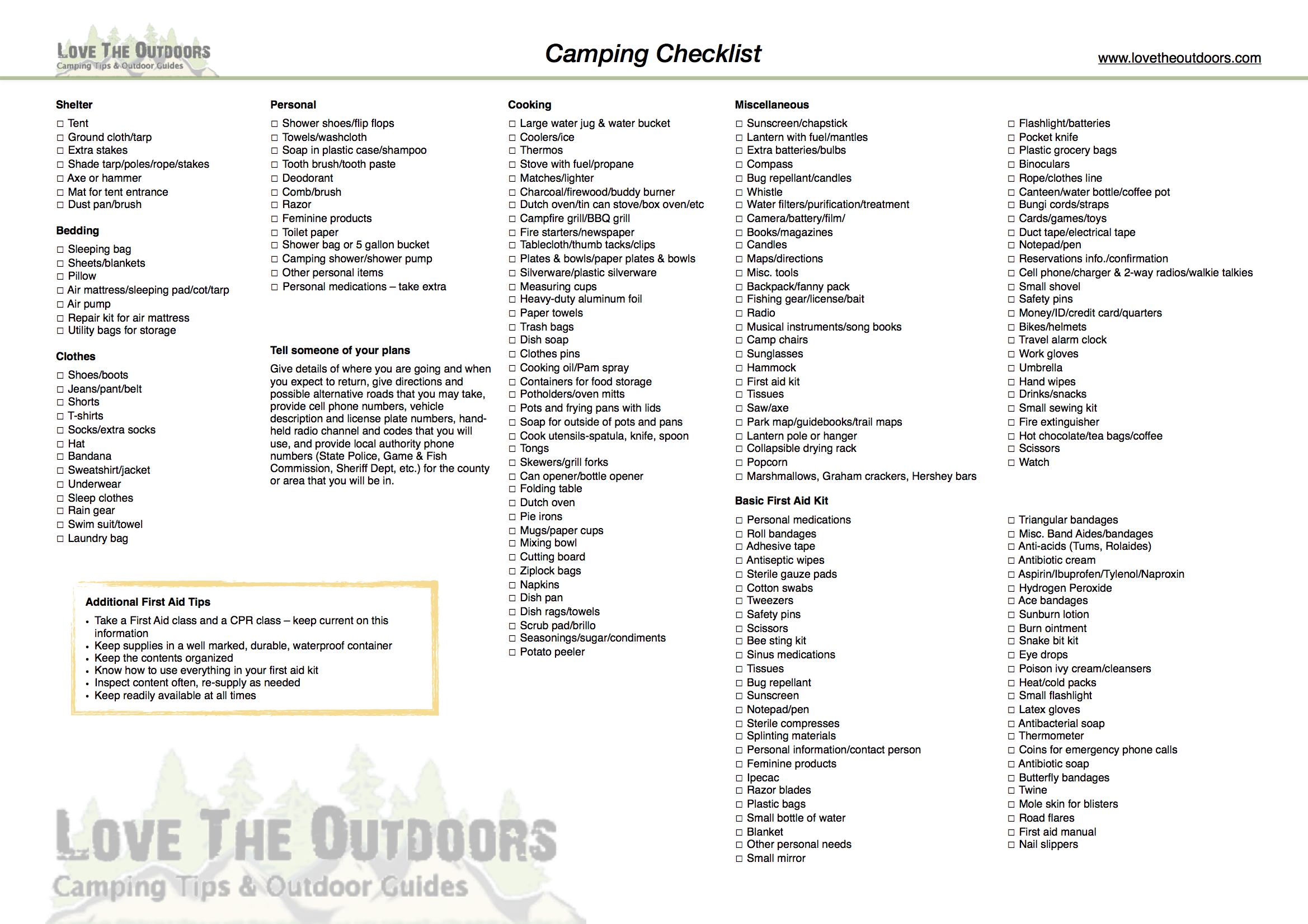
  • Failure to complete some minimal pre-planning for your trip could be a big mistake.  Use a written checklist to help keep organized.  This should be checked and double-checked before leaving home for your camping trip.
  • Failing to protect yourself from wild animals while camping or hiking can be the cause of inconvenience, injury or even death.  It's important to know what type of wildlife frequents the area you're planning to visit to take precautions to deter visits from critters and to protect yourself and your family.  Click here to find out more.
Bears in the Wild

Besides potential visits from small animals such as raccoons, possums or skunks, bears can be a real problem in some camping areas, especially if you're not in an established campground.  It's a mistake not to know how to deter bears from invading your campsite ore, if they do, how to react to them.  Bears coming into your camp are there for one reason - they want food (and human beings are not their preferred or typical food).  Consider these important tips:
  1. Your food should be stored and cooked at least 100 yards away from where you'll be sleeping.
  2. Food should not be kept in your tent.
  3. Don't bed down in the same clothes you wore while cooking.
  4. Food should be kept in airtight containers and a locking cooler.  These can be tied with rope and hoisted up a pole or a tree, at least seven feet from ground level.  As an alternative, lock food in your car trunk. 
  5. Bears are attracted to garbage.  Put yours in doubled plastic bags and store in your car trunk.
  6. If you meet a bear out on the trail don't make eye contact.  Speak in a low, calm voice while backing up.  Don't turn your back on a bear or run away.  Spray with bear repellent spray.


Monday, March 15, 2021

How To Choose an Insurance Company


Buying insurance can be a potentially overwhelming experience due to the vast number of confusing definitions, conditions, exclusions and coverages involved.  On top of this, you want to choose an insurance company that's well-regarded in the industry, financially strong, with a good claims history and top reviews from clients with whom they've done business.  Here's a breakdown of several factors to consider when you're trying to choose an insurance company:

  • Understand the difference between an independent insurance agent or broker and an insurance company agent.  An independent agent likely has access to policies from numerous different insurance providers.  While an insurance company agent can only write policies from his or her own company, the independent agent can write whatever policy is best suited to your particular insurance needs.  To make matters even simpler, an independent will do the research and legwork to find the best choices and then provide you with multiple options to consider.
  • When considering a particular insurer, research their history and look into their reputation.  How long have they been in business?  What products do they offer and in what states are they sold?  What can be said about their company leadership and community involvement?  What are their professed vision and values?
  • Assess the financial strength of a company you're considering and don't accept any insurance offer from a firm with less than an "A" (excellent) rating.  A.M. Best is the #1 independent insurance company rating-company in the U.S., but you can find several others here.
  • Choose an insurance company that sells the type of insurance coverage you need.  Many companies give discounts for customers who carry multiple policies (e.g., homeowners, life, vehicle) with them, so check into this.  Check for all other discounts.
  • While price is an important consideration for most people when they choose an insurance company, it shouldn't be the only consideration.  A lower price may mean a lower level of coverage, so always compare apples to apples.  Keep in mind the old axiom that you get what you pay for.  There may be a number of reasons for the price differences between different companies.  One may be because the lower priced is new to the market, which may mean it's lacking in experience.

Get with a trusted broker and explore the companies and coverages available.  Seek professional guidance and utilize their ability to uncover the best protection at the fairest price available.

Tuesday, March 9, 2021

Car Insurance: Teen Driver Discounts


As the parent of a teenage driver, you're not only becoming aware of how quickly your son or daughter is growing up to be an adult but also seeing the looming cost involved with teen driver insurance.  Fortunately, help is available.  Read on to learn about teen driver discounts and other ways to save money when insuring your teen driver.

Why Teens Are So Expensive to Insure

The reason teen drivers are more expensive to insure than drivers 25 years and older is because they represent a higher claims risk to insurers.  This may be due to:
  • Their inexperience
  • Their likelihood to speed, drive after drinking and not use seatbelts, causing them to have more accidents and submit more claims
Money-Saving Teen Driver Insurance Tips

Consider these teen driver insurance tips:

  • As with the purchase of any insurance, experts agree that the number one rule before buying is to shop around.  Best advice is to obtain at least three price quotes from different providers.  The easiest way to do this is to utilize the services of a quality insurance broker with access to numerous different insurance companies.  They'll do the legwork and then present you with a number of options for the coverage best suited to your particular needs.  In this case, you'll want quotes from companies that specialize in teen driver's insurance
  • While adding a teen driver to your existing car insurance coverage will add significantly to your current coverage costs, it's still less expensive than having your teen obtain their own, separate policy.  Having your teen complete a safe teen driving program or other defensive driving course can help lower the cost of your insurance policy
  • Other valuable teen driver discounts offered by many vehicle insurance companies include a good student discount for students maintaining a "B" average (3.0 GPA) or higher at school.  This particular discount can often mean 10-15% off of coverage costs.  Add to this a distant student discount and a low mileage discount

The Advantage of Telematics

Some insurers offer installation of a small telematics device into your teen's car so you can monitor their driving behavior.  Positive results of driving habits may bring a driving insurance discount.  A telematics device can keep track of number of miles driven, speeds driven, times driven and number of hard brake applications.  Knowing they're being monitored in itself may prove to make your teen a safe driver.